A Portfolio Perspective
Fifteen years ago, venture capitalist Marc Andreessen famously wrote that “software is eating the world.” Today, AI represents the next phase of that transformation. Cloud computing, SaaS, and digital platforms have already reshaped entire industries, and artificial intelligence is now prompting markets to reassess what this means for specific sectors and the broader economy. For long-term investors, maintaining perspective on how these cycles have unfolded can provide helpful clarity.
The recent sell-off and quick rebound in technology stocks illustrate how difficult it is to predict these trends. Anthropic’s new automation tools sparked a reassessment of traditional software business models, while large technology companies reported over a hundred billion dollars in quarterly AI infrastructure spending. Ironically, this followed last January’s “DeepSeek moment,” when a Chinese AI company showed models could be built at a fraction of the cost. In both cases, markets quickly recalibrated—a reminder that long-term perspective matters most.
Technological disruption follows familiar patterns
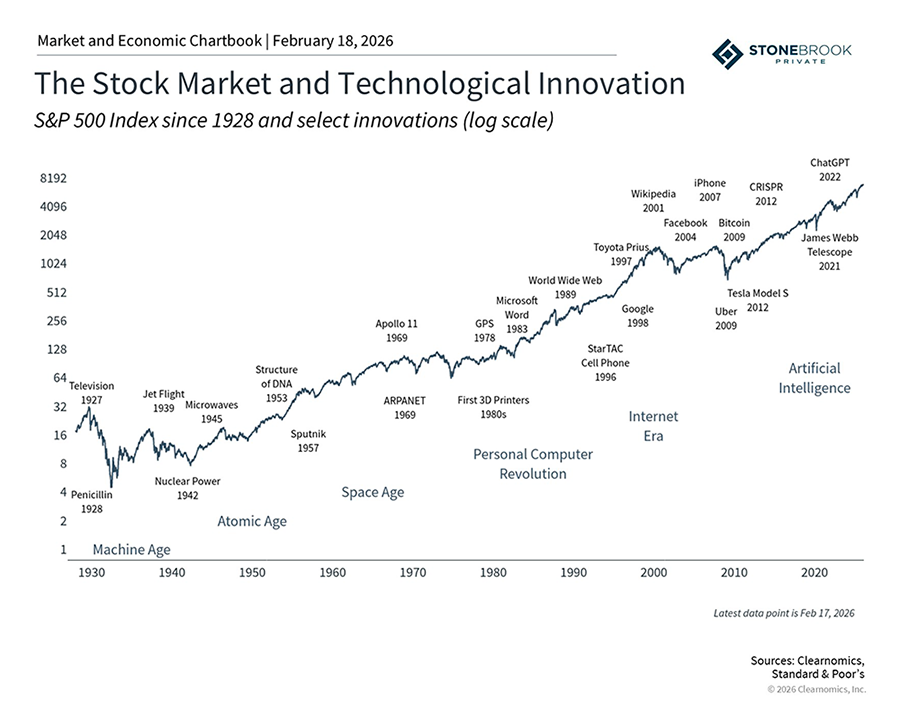
The current uncertainty around AI may feel unprecedented, but history shows that technological disruptions follow similar patterns. Our use of software has evolved from boxed products installed on a single computer to the foundation of how we work, communicate, shop, and entertain ourselves. In every wave of innovation, markets must determine which companies fall into the “old economy” and which into the “new.”
AI has the potential to change how services are created, continuing the trend of traditional processes being replaced by software. However, even the most transformative technologies don’t eliminate the need for specialized expertise. AI systems will still require access to the best data, reliable platforms, and unique domain knowledge. Consumers will continue to value trust, personalization, and quality outcomes.
Which companies are most competitive may change over time, but underlying fundamental needs will likely remain the same. Just as you wouldn’t build a car yourself every time you needed to drive to the store, AI applications will still rely on existing infrastructure and specialized services. Over time, this tends to benefit consumers through smarter products, lower costs, and greater accessibility.
It’s also important to maintain realistic expectations about the pace of change. While AI companies have predicted the arrival of “artificial general intelligence” over the past several years, recent evidence suggests training progress has slowed somewhat. That said, what current AI systems can accomplish is already remarkable and clearly enough to reshape investor expectations.
The labor market adds to economic uncertainty
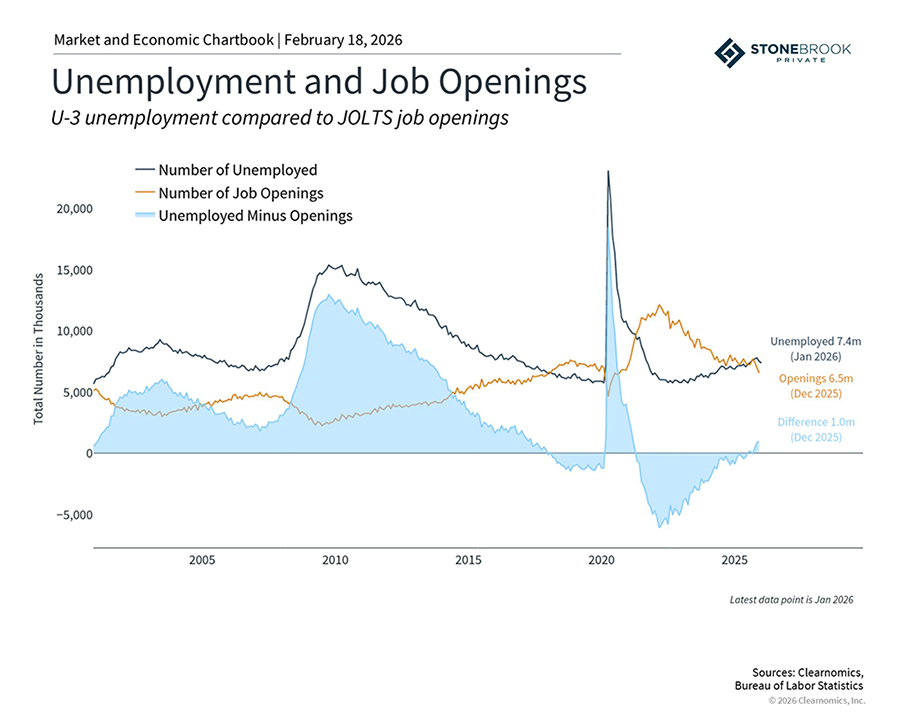
Adding to investor concerns is a labor market that has weakened since mid-2025. Job openings fell to their lowest level since 2020 in December, with the ratio dropping below one opening per job seeker. Meanwhile, Challenger, Gray & Christmas reported that January job cuts soared to 108,435—a 118% year-over-year jump and the highest level for the month since 2009.
There is no direct evidence yet that these cuts are AI-related, but the trends affect the broad economic outlook nonetheless. Every major technological wave has eventually created more jobs than it replaced, but transition periods as workers are retrained can be difficult for both individuals and society.
A weaker job market has raised concerns after years of better-than-expected growth, with implications for the broader outlook and Fed policy. That said, other economic data remain healthy: consumer spending continues to be driven by household wealth near record levels, and inflation has held steady below 3%. While there are challenges, there is also reason to believe the economy can continue to grow at a healthy pace.
What these trends mean for portfolios
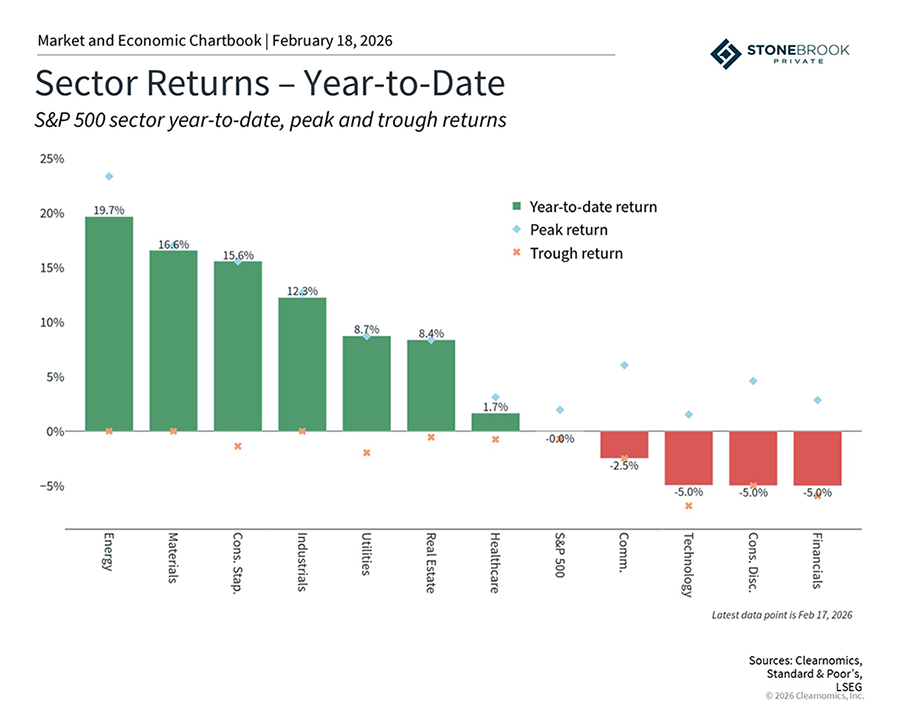
For investors, recent volatility underscores the principle that asset allocation matters more than any single trend or headline. The Information Technology and Communication Services sectors, while delivering strong returns in recent years, are sensitive to shifts in expectations and long-term factors such as interest rates. Groups like the Magnificent 7 can struggle in periods like 2022—and over the past two months.
Perhaps the biggest question is around stock market valuations. With the S&P 500’s price-to-earnings ratio near historically elevated levels, investors have been rotating into sectors such as Consumer Staples, Energy, Materials, and Industrials. This possibly reflects markets becoming more selective and focusing on opportunities beyond AI.
Cryptocurrencies have also experienced a significant pullback, with Bitcoin falling 50% to just above $60,000 before rebounding somewhat. From a portfolio perspective, this is a reminder that crypto remains highly volatile, sensitive to shifts in sentiment, and subject to evolving regulatory frameworks. For those interested, deciding how these assets fit into a balanced portfolio is far more important than trying to time the market.
Ultimately, today’s AI trends should be viewed in a broader context alongside other changes to the market and economic landscape. If past cycles are any indication, markets will likely over- and underreact to these trends in the short run. History suggests that those who stay patient and properly diversified tend to be better positioned to pursue their long-term financial goals.
The bottom line? While AI is leading to a reassessment of specific stocks and sectors, the principles of long-term investing remain as relevant as ever. Maintaining a well-diversified portfolio aligned with your financial goals remains the most prudent way to navigate periods of rapid change.

Disclosure:
Stonebrook Private LLC (“Stonebrook”) is a federally registered investment adviser under the Investment Advisers Act of 1940. Registration as an investment adviser does not constitute an endorsement of Stonebrook by the SEC nor does it indicate that Stonebrook has attained a particular level of skill or ability. This material is provided for educational and informational purposes only and does not constitute investment advice, a recommendation, an offer to buy or sell, or a solicitation of any security, strategy, or investment product. All investing involves risk, including the possible loss of principal. Past performance is not indicative of, and is no guarantee of, future results. Diversification and asset allocation do not ensure a profit or protect against loss in declining markets. Information herein was obtained from various sources believed to be reliable; however, Stonebrook does not guarantee, and accepts no liability for, the accuracy or completeness of information provided by third parties. Charts and data are provided by Clearnomics, Inc. and other third-party providers. Sources may include Standard & Poor’s, LSEG, Bureau of Labor Statistics, and similar providers. Indexes are unmanaged and not investable. Index performance does not reflect the deduction of advisory fees, transaction costs, or other expenses.